Why Your Gums Bleed When You Brush — And When to Take It Seriously

Man checking his gums and looking disturbed.
If your gums bleed every morning when you brush, you've probably already explained it to yourself in one of a few ways. You brushed too hard. The bristles are too firm. It happens to everyone. It's nothing.
The third one is particularly worth examining. It's not nothing, and it doesn't happen to everyone with healthy gums. Bleeding gums during brushing is a sign of inflammation, and inflammation always has a cause.
What Healthy Gums Look Like and Do
Healthy gum tissue is firm, stippled (slightly textured, like orange peel), and pale pink. It fits snugly around each tooth with a shallow crevice called the sulcus — typically 1 to 3 mm deep. When a toothbrush or piece of floss touches healthy gum tissue, nothing happens. No blood, no pain, no response beyond the mechanical contact.
This sounds obvious, but it's worth stating clearly: healthy gums do not bleed when touched. Bleeding is pathological. It means the tissue is inflamed.
The Inflammation Mechanism
Gingivitis — inflammation of the gum tissue — produces a cascade of changes in the gum vasculature. Blood flow to the inflamed area increases. Blood vessels in the gum tissue multiply and become more numerous and more fragile. The gum tissue swells slightly, becomes softer, and changes from its normal pale pink to a darker red.
These fragile, engorged blood vessels sit close to the gum surface. When a toothbrush bristle contacts the gumline, these vessels rupture. That's the blood.
The same mechanism explains why gums bleed on flossing — and why patients should not interpret this as a reason to stop flossing. Gums that bleed on flossing are inflamed from undisturbed plaque between teeth. Flossing removes that plaque. The bleeding reduces as inflammation resolves. Stopping flossing removes the intervention that would have fixed the problem.
What's Driving the Inflammation
Almost universally, the answer is plaque.
Dental plaque — the bacterial biofilm that adheres to tooth surfaces — accumulates continuously. Within hours of brushing, it begins forming again. The bacteria in plaque produce toxins that trigger an immune response in the adjacent gum tissue. The gum tissue becomes inflamed in proportion to how much plaque has accumulated and how long it's been undisturbed.
At the gumline and between teeth — where most people's brushing is least effective — this plaque can sit undisturbed for days between brushing sessions. The gum tissue around these areas becomes chronically inflamed.
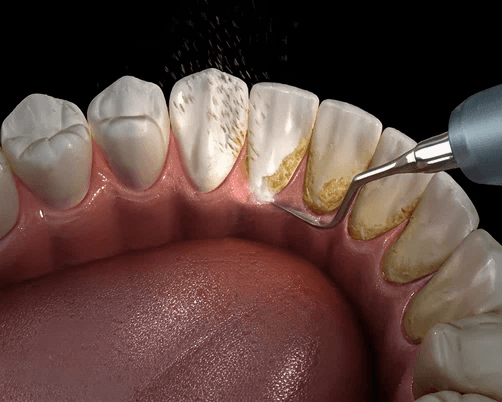
Calculus compounds this. Plaque that isn't removed within 48 to 72 hours mineralises — calcium and phosphate from saliva incorporate into it and harden it into calculus. Calculus can't be removed by brushing. It maintains a constant bacterial presence at the gumline regardless of how well the patient brushes. Professional scaling is the only removal method.
This is why some patients brush conscientiously twice daily and still have bleeding gums: the calculus that's driving the inflammation is still there, no matter how good the brushing.
Brushing Technique as a Direct Cause
A less common but worth-knowing scenario: the brushing itself is causing the gum damage.
Patients who brush horizontally with a hard-bristled toothbrush, particularly with significant force applied at the gumline, physically traumatise the gum tissue. The gum doesn't inflame the same way as gingivitis — it recedes. The gumline pulls back from the tooth, exposing root surfaces, creating sensitivity, and leaving the area more vulnerable to further damage.
This pattern produces a specific appearance: recession concentrated on the buccal (cheek-facing) surfaces of teeth in the areas brushed most vigorously, with notching at the cervical area where the bristles hit hardest.
If your bleeding is concentrated at specific teeth that you know you focus on, and your gums look like they're pulling back rather than swelling, brushing technique is likely the primary issue. Switch to soft bristles and a gentler, more circular stroke at the gumline.
Other Contributing Factors
Plaque is the primary driver. Several other factors increase gum tissue susceptibility
1. Vitamin C deficiency. Gum collagen requires vitamin C for synthesis. Without adequate vitamin C, gum tissue becomes structurally fragile. Even mild deficiency produces gums that bleed more readily — it effectively lowers the threshold for bleeding in response to the same plaque burden.
2. Pregnancy. Elevated oestrogen and progesterone during pregnancy amplify the gum tissue's inflammatory response to plaque. The same amount of plaque that caused no symptoms before pregnancy can cause significant gum swelling and bleeding during the second and third trimesters. Pregnancy gingivitis is common, manageable with professional cleaning, and resolves after delivery.
3. Poorly controlled diabetes. Hyperglycaemia impairs the immune response to oral bacteria and delays tissue healing. Gum disease is both more common and more severe in uncontrolled diabetics.
4. Medications. Blood thinners (aspirin, warfarin, newer anticoagulants) mean that any gum bleeding, however minor, is prolonged and more visible. Certain medications also cause gum overgrowth (gingival hyperplasia), which makes the tissue harder to clean and more prone to inflammation.
5. Smoking. This one is counterintuitive: smokers often bleed less from their gums than non-smokers with equivalent gum disease, because nicotine constricts blood vessels. This makes gum disease harder to detect by bleeding signs, not easier — the disease progresses without the warning signal. Smokers have significantly higher rates of periodontitis and bone loss.
How Long Does It Take for Gums to Stop Bleeding?
With genuinely improved home hygiene — soft-bristled brush, proper gumline technique, daily flossing — gum inflammation from mild gingivitis typically resolves visibly within 2 to 3 weeks. Bleeding reduces progressively as the bacteria are consistently removed and the inflammation subsides.
If bleeding is not improving after 2 to 3 weeks of consistent, correct oral hygiene, there is almost certainly calculus that's maintaining the inflammation despite the improved brushing. This needs scaling at the dental clinic — it won't resolve without professional intervention.
What a Dentist Assesses When You Have Bleeding Gums
At Renew Dental Clinic in Sector 47, Noida, Dr. Suchi Singh doesn't just note that the gums bleed. She assesses:
1. Pocket depth: Using a periodontal probe, she measures the depth of the crevice around each tooth. Healthy sulci are 1 to 3 mm. Deeper pockets indicate periodontitis — the infection has extended below the gumline and structural damage may have begun.
2. Bleeding on probing: A standardised measure of gum inflammation at each tooth site. This gives an objective picture of which areas are inflamed rather than relying on what the patient describes.
3. Calculus distribution: Where tartar has accumulated above and below the gumline — which determines whether simple scaling or deeper root planing is needed.
4. Bone levels on X-ray: Whether the bone supporting the teeth has been affected by the ongoing infection.
5. Systemic factors: Medical history review to identify medications, conditions, or deficiencies that may be contributing.
This assessment takes the bleeding gums from a vague symptom to a specific clinical picture that can be treated appropriately.
The Pattern That Definitely Needs a Dentist's Assessment
See Dr. Suchi Singh at Renew Dental Clinic if
- Bleeding has persisted despite 2 to 3 weeks of improved home hygiene
- Gums are significantly swollen, dark red, or tender
- Bad breath persists despite good brushing and tongue cleaning
- Gums look like they're receding — particularly around multiple teeth
- Teeth feel even slightly mobile or have shifted position
- You're pregnant and experiencing gum swelling or bleeding (professional cleaning during pregnancy is safe and important)
- You're diabetic — the gum disease / blood sugar relationship requires active management
To book a gum assessment at Renew Dental Clinic, Sector 47, Noida, call (0120) 498-8333.
Monday–Saturday 10:30 AM – 8:00 PM | Sunday 11:00 AM – 2:30 PM.