White Spots on Teeth — What Causes Them and How to Get Rid of Them

A glossy, healthy white tooth surrounded by floating mint leaves and ice cubes, symbolizing dental freshness and hygiene.
You notice a chalky white patch on a tooth. Maybe it's been there for years without change. Maybe it appeared recently. Maybe it showed up after your braces came off and you've been wondering about it ever since.
White spots on teeth are one of those things where the visual is the same but the story behind it is completely different depending on the cause. Early tooth decay, fluorosis, enamel hypoplasia, and simple dehydration can all produce white patches on enamel — and the treatment for each is different. Getting this wrong means spending months trying to reverse something that was never going to respond to what you were doing.
What the White Colour Actually Tells You
Healthy enamel is slightly translucent — it has a warm, glassy quality when light hits it. A white spot appears when the enamel loses its translucency and becomes more opaque. This opacity comes from changes in the mineral structure of the enamel.
The question is what caused that change. Four main culprits cover the vast majority of white spots you'll encounter.
Early Tooth Decay (White Spot Lesions)
This is probably the most clinically significant type and the one most worth catching early. When plaque bacteria produce acid and that acid contacts enamel repeatedly, mineral content begins to dissolve from the enamel surface in a process called demineralisation. The affected enamel becomes porous and loses its translucency — appearing chalky white.
This is still reversible at this stage. The enamel surface hasn't actually broken down; it's just lost mineral density. With fluoride treatment and changes to the acid exposure causing it, remineralisation can restore the enamel's mineral content and the white spot can fade.
Left longer, the softened enamel eventually collapses — the white spot becomes a cavity, which requires drilling and a filling. This transition from white spot lesion to actual cavity is the moment prevention stops being an option.
How to identify this type: they typically appear in areas where plaque accumulates most — at the gumline, between teeth, or in the grooves of molars. They may look slightly dull or chalky rather than bright white. On a young child's teeth, a white spot near the gumline of a front tooth is an urgent sign of early childhood decay.
Fluorosis
Fluorosis occurs when children ingest too much fluoride during the years when their permanent teeth are developing — typically from birth to about age eight. The fluoride disrupts the ameloblast cells responsible for enamel formation, producing a range of changes from faint white lines or spots to more extensive yellowish-brown mottling in severe cases.
Mild fluorosis produces white streaks or flecks that are barely noticeable. The teeth are actually structurally sound — fluorosis doesn't weaken enamel in mild forms. Moderate and severe fluorosis produces more obvious discolouration and surface pitting.
In India, fluorosis is relevant in two contexts. First, regions with naturally high fluoride in groundwater — parts of Rajasthan, Gujarat, Andhra Pradesh — have historically higher fluorosis rates in populations using bore well water. Second, excessive toothpaste ingestion in young children who haven't been taught to spit is a well-documented cause of mild fluorosis in the permanent teeth developing at that time.
Fluorosis-related white spots cannot be reversed — they're structural changes within the formed enamel. But they can be treated aesthetically with microabrasion, composite bonding, or veneers depending on severity.
Enamel Hypoplasia and Hypomineralisation
A somewhat catch-all category for white (or yellowish-brown) spots that result from disrupted enamel formation — usually from illness, high fever, or nutritional deficiency during tooth development.
Molar-Incisor Hypomineralisation (MIH) is the most clinically recognisable form — it affects the first permanent molars and often the upper front incisors, producing white, yellow, or brownish patches of enamel that are structurally weakened. These teeth are prone to rapid decay, sensitivity, and enamel chipping under normal chewing forces.
MIH affects roughly 10–15% of children globally and is increasingly recognised in Indian dental practice. Children who had high fevers, significant illness, or antibiotic exposure in the first two years of life are at higher risk.
Unlike fluorosis, hypomineralised enamel is genuinely weaker than normal enamel and more susceptible to decay. Management depends on severity — fluoride protection for mild cases, composite restorations or crowns for more severely affected teeth.
Dehydration — Temporary and Easily Confused
This one surprises most people. Enamel contains water, and when the mouth is very dry — after sleeping with the mouth open, after a long run, or during significant dehydration — enamel temporarily loses some of its water content and appears whiter and more opaque.
White spots that appear in the morning and fade within an hour of eating and drinking are almost certainly dehydration-related. Absolutely nothing to worry about. Not a sign of decay, not fluorosis, not a structural problem.
Patients who see white spots in the mirror after waking and search frantically for causes will often be reading about fluorosis and early decay when what they have is simply a dry mouth overnight.
Can White Spots Be Reversed?
The honest answer: it depends on what caused them.
Early decay white spot lesions — yes, if caught early enough. The window is before the enamel surface physically breaks down. Professional fluoride varnish applied at the dental clinic is the most effective remineralisation treatment. Casein phosphopeptide-amorphous calcium phosphate (CPP-ACP) products, available as Tooth Mousse (GC) at dental clinics, also support remineralisation of early lesions. At-home high-fluoride toothpaste (available on dental prescription) helps maintain progress.
Fluorosis white spots — cannot be reversed (the enamel formed incorrectly and won't reform), but they can be masked or reduced aesthetically. Options depend on severity.
Enamel hypoplasia/MIH — cannot be reversed; management is protective and restorative.
Dehydration spots — self-reversing. They go away on their own once the mouth rehydrates.
Treatment Options — From Least to Most Invasive
Fluoride varnish and remineralisation products are the starting point for early decay white spots. Applied professionally at every check-up, fluoride varnish at 5% sodium fluoride concentration provides enamel protection far stronger than anything available over the counter. The Tooth Mousse product mentioned above can be applied at home after professional assessment.
Microabrasion is a technique where a mildly abrasive acid compound is applied to the white spot and gently worked across the surface, removing a very thin outer layer of enamel along with the discolouration. This works for white spots that are confined to the very outer enamel — fluorosis and some hypoplasia cases. Results are often very good. The technique removes a negligible amount of enamel and is conservative.
Composite resin bonding places tooth-coloured resin material over the white spot to mask it. Effective for more extensive discolouration. Requires a small amount of enamel preparation in some cases. Results last 5–8 years before the bonding may need refreshing.
Porcelain veneers for severe cases where the discolouration covers large areas of the visible tooth surface and other methods haven't produced adequate results. Most conservative and durable option for significant cosmetic concerns.
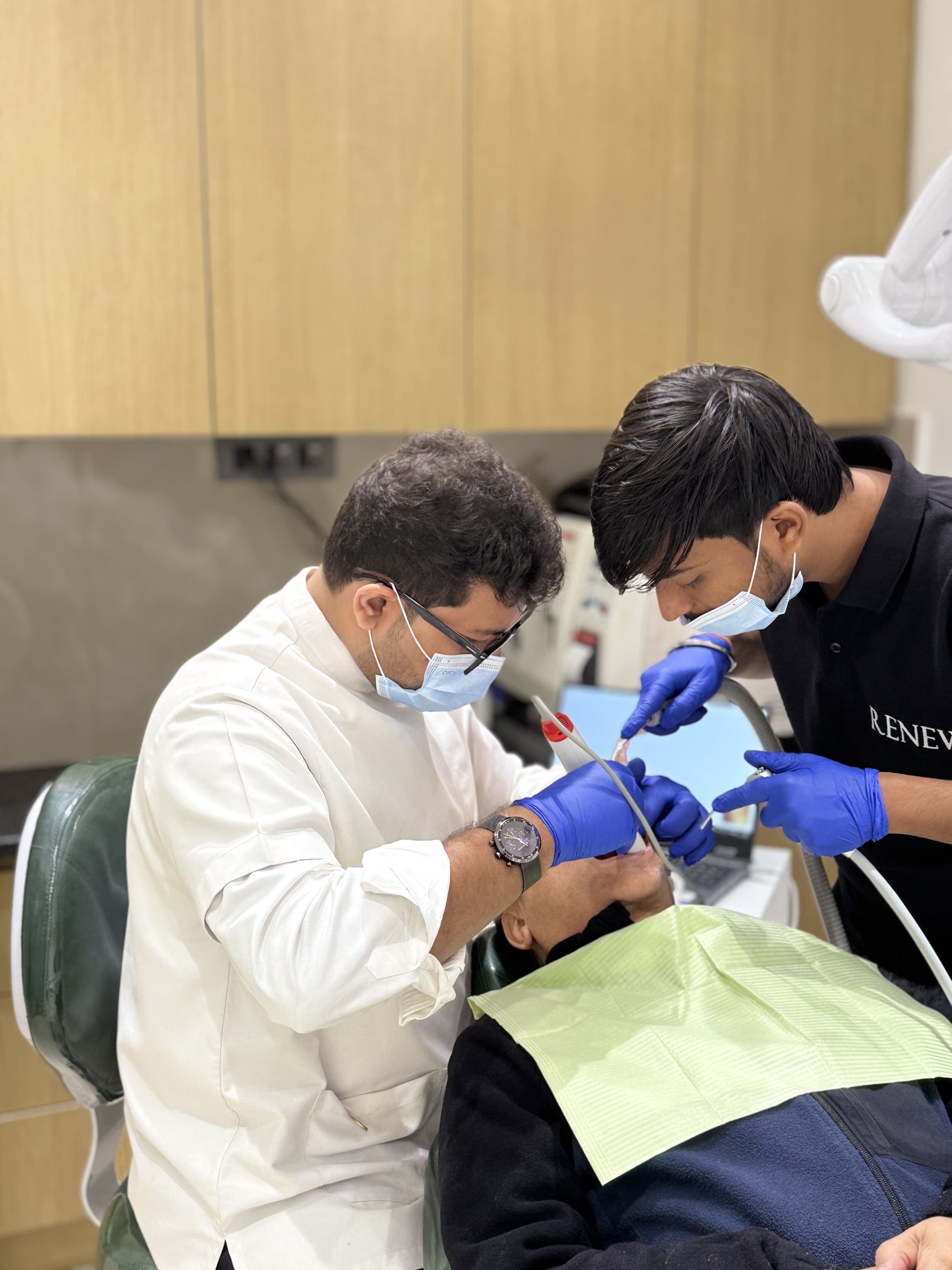
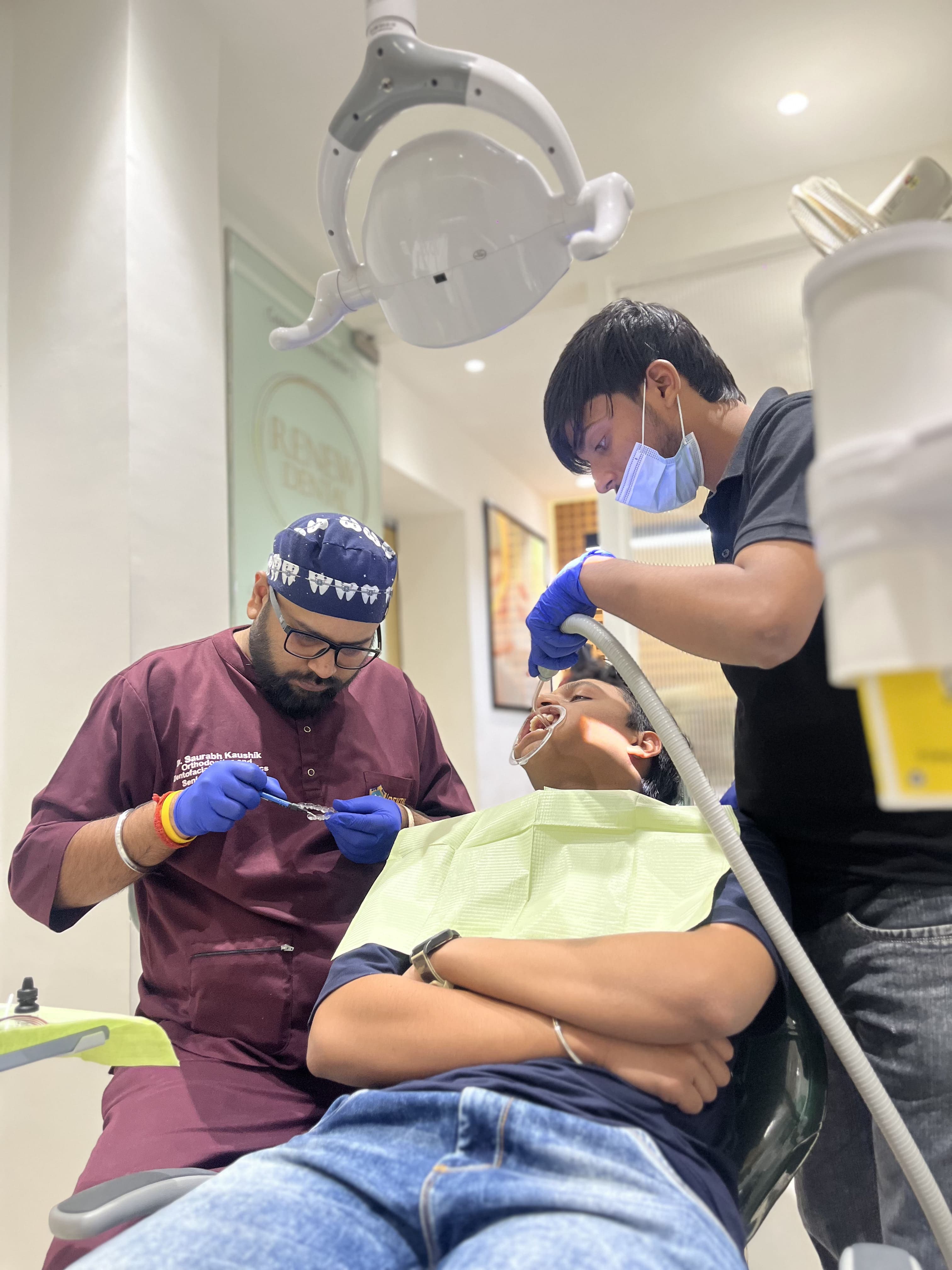
At Renew Dental Clinic in Sector 47, Noida, Dr. Suchi Singh assesses white spots specifically — determining the likely cause, whether it's progressing, and which treatment pathway makes sense. Many patients arrive having assumed they need veneers when microabrasion or simply a fluoride programme was all that was needed.
White Spots After Braces — A Common Specific Situation
This deserves its own mention because it's extremely common and consistently distressing for patients. White spot lesions around orthodontic brackets appear when plaque accumulates at the bracket margins and the resulting acid demineralises the enamel directly adjacent to the bracket.
These spots are exactly the early decay type described above — they're reversible if caught early and treated with fluoride remineralisation. Many resolve significantly within the first year after braces removal with proper fluoride use. Some persist and require microabrasion or composite bonding.
The prevention is rigorous oral hygiene during brace treatment — something the orthodontic team at Renew Dental emphasises consistently for patients in active treatment.
Frequently Asked Questions
Q: I've had a white spot on the same tooth for five years and it hasn't changed. Should I still see a dentist?
A: A stable white spot that hasn't changed in years is much less concerning than a progressive one. That said, having it assessed and photographed at a check-up gives you a documented baseline. If it's been stable, it's unlikely to be active decay.
Q: My child has a white patch on their newly erupted molar. Is this serious?
A: Possibly. A white or yellowish-brown patch on a first permanent molar (which erupts around age 6) is one of the classic presentations of MIH. Get it assessed promptly — these teeth need protective management, and the sooner it's identified, the better the options.
Q: Can toothpaste fix white spots?
A: Not entirely. Regular fluoride toothpaste supports remineralisation of early decay spots but slowly. High-fluoride prescription toothpaste produces better results. Whitening toothpaste is not the right choice here — its abrasiveness isn't helpful for this type of concern.
Q: Is microabrasion painful?
A: No. It's done in the dental clinic without anaesthesia in most cases. The sensation is mild pressure and a slightly unusual taste from the acid compound used. It takes about 15–30 minutes depending on how many teeth need treatment.
Q: Are the white spots from fluorosis harmful to my health?
A: Mild fluorosis is a cosmetic issue only. Moderate to severe fluorosis can weaken enamel structure, making affected teeth more susceptible to chipping and decay, but the fluoride itself is not a health risk at the levels that cause cosmetic fluorosis.
For an assessment of white spots — whether for your own teeth or your child's — contact Renew Dental Clinic, Sector 47, Noida.
📞 +91 99710 35300
A-321, Basement Floor, Next to Mother Dairy Store, Sector 47, Noida, Uttar Pradesh 201303
Monday–Saturday 10:30 AM – 8:00 PM | Sunday 11:00 AM – 2:30 PM