Is Chewing Gum Good for Your Teeth? What Dentists in Noida Actually Say
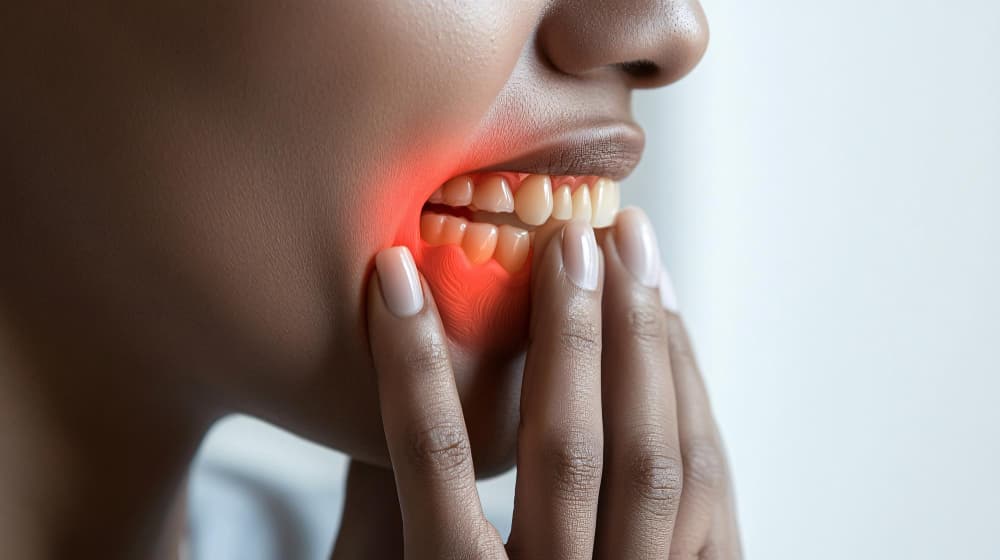
Closeup of person clutching painful jaw in bedroom setting
There's a one-word answer to this question, and it isn't very useful. Yes — with heavy qualification. No — for most of the gum people actually buy and chew.
The real story is about what's in the gum. Regular chewing gum with sugar is actively bad for your teeth. Sugar-free gum with xylitol has genuine, research-backed dental benefits. And that distinction is almost never made in the advertising.
The Mechanism — Why Gum Can Help at All
Chewing anything — gum, food, a piece of bread — stimulates saliva production. The physical act of mastication activates salivary glands, and the flavour receptors in the mouth amplify this further. Saliva production increases 10 to 12 times its resting rate during chewing.
That matters because saliva does a lot. It buffers acid in the mouth, washing away and neutralising the acid produced by bacteria after meals. It delivers calcium and phosphate to the enamel surface, supporting remineralisation of early damage. It physically rinses food particles and bacteria off tooth surfaces. When you're dry-mouthed — from dehydration, medication, or stress — you lose all of that.
So the act of chewing gum for 20 minutes after a meal, triggering increased saliva flow, does provide a genuine protective benefit. This is why clinical trials have found reduced cavity risk in people who chew sugar-free gum after meals compared to those who don't.
The American Dental Association gives its Seal of Acceptance only to sugar-free gums. That seal exists because the evidence is real.
The Xylitol Difference
Not all sugar-free gums are equal. The sweetener matters.
Sorbitol and mannitol are the most common sugar alcohols in standard sugar-free gum. They're non-cariogenic — bacteria can't ferment them into acid easily. So they don't cause cavities. That's the benefit.
Xylitol goes further. It doesn't just fail to feed bacteria — it actively disrupts them.
Streptococcus mutans (the primary cavity-causing bacterium) takes xylitol into its metabolic cycle expecting to extract energy from it, but can't — the chemical structure is similar enough to glucose to be absorbed but different enough to be unusable. The result is what researchers call a "futile energy cycle" — the bacterium expends energy it can't recover, and dies.
Regular xylitol exposure:
- Reduces S. mutans levels in plaque and saliva
- Decreases plaque adhesiveness — the biofilm becomes less sticky and easier to remove
- Increases salivary flow (from chewing) and pH
- Has been associated in some studies with enamel remineralisation
A 2022 study published in Frontiers in Nutrition found that participants chewing xylitol gum for two weeks showed a significant reduction in the weight of dental plaque and the abundance of pathogenic bacteria compared to a control group. Studies among children showed reduced cavity progression and even reversal of early lesions with sustained xylitol use over 12 to 40 months.
The recommended therapeutic dose is 6 to 10 grams of xylitol per day, spread across at least three exposures. Most commercial xylitol gums contain 0.7 to 1.5g per piece, so you'd need three to eight pieces a day across the day to hit that range. That's more gum than most people chew, but even lower amounts contribute some benefit.
What Gum Cannot Do
This needs to be said plainly.
Chewing gum doesn't clean teeth. It doesn't remove plaque. It doesn't replace brushing. It doesn't replace flossing. It doesn't reach between teeth or below the gumline. It's an adjunct — something useful in addition to a proper hygiene routine, not instead of one.
The research showing cavity-reducing effects from xylitol gum is largely conducted in people who are also brushing. The gum adds benefit on top of existing hygiene; it doesn't compensate for the absence of it.
If you're eating lunch out and can't brush afterward — chewing a piece of xylitol gum for 20 minutes is a reasonable substitute for the post-meal rinse and is better than nothing. But it's not the same as brushing.
When Gum Is a Bad Idea
A few specific situations where chewing gum actively makes things worse
Temporomandibular joint (TMJ) problems. If you have jaw pain, clicking, or difficulty opening your mouth fully, sustained chewing puts repeated load on already-stressed joint structures. Xylitol-containing lozenges or mints give the xylitol benefit without the mechanical chewing.
Braces. Most orthodontists prohibit gum during fixed brace treatment — it sticks to brackets, dislodges ligatures, and can interfere with archwire positioning.
After dental procedures. Following extractions, oral surgery, or new fillings, chewing gum risks disturbing healing tissue, dislodging clots, or stressing new restorations. Wait until the site has healed.
If it contains sugar. Obvious, but worth stating. Chewing sugary gum for 20 minutes multiple times a day is significantly more damaging than not chewing gum at all — it continuously exposes the teeth to fermentable substrate that bacteria convert to acid.
A Practical Guide to Choosing the Right Gum
The label matters. Things to check:
1. Does it say "sugar-free"?
Non-negotiable. Anything sweetened with sucrose, glucose, or fructose feeds bacteria.
2. Is xylitol listed in the first few ingredients?
Ingredients are listed in descending order of quantity. If xylitol is fifth or sixth behind other sweeteners, the amount is small. For genuine dental benefit, xylitol should be among the primary sweeteners.
3. Does it have the ADA Seal of Acceptance or BIS certification?
These indicate third-party verification of safety and efficacy claims.
4. Is there a mint or cinnamon flavour?
These flavours trigger stronger taste receptor stimulation, which increases saliva production. Slightly better than unflavoured from a saliva perspective.
In India, xylitol gums are available but require checking labels carefully — most chewing gum in Indian supermarkets and paan shops is sugar-sweetened. International brands available at supermarkets or imported product stores are more likely to carry properly formulated xylitol gum.
What Patients at Renew Dental Clinic Are Told
Dr. Suchi Singh's recommendation at Renew Dental Clinic in Sector 47, Noida is consistent: for patients who want to do something additional between brushing — particularly after meals when brushing isn't immediately possible — sugar-free xylitol gum for 20 minutes is a reasonable and evidence-supported choice.
It's not transformative on its own. It's one component of oral hygiene, not a replacement for any other.
For patients with TMJ pain, it's not recommended. For patients with active gum disease where the primary need is to reduce subgingival bacteria (which gum cannot reach), scaling and root planing is the relevant treatment — not gum.
Context matters, and that's why the question "is gum good for my teeth?" gets a different answer depending on who's asking.
Frequently Asked Questions
1. Is chewing gum addictive?
Not chemically. Some people develop the habit of constant chewing, which can stress the jaw joints over time. If you find yourself chewing continuously throughout the day, it's worth being aware of the TMJ implications.
2. Can children chew xylitol gum?
Yes, with supervision. Xylitol gum shouldn't be swallowed — younger children who might swallow it should stick to xylitol lozenges or syrup formulations designed for them.
3. Is gum safe for people with diabetes?
Xylitol has a low glycaemic index and does not cause blood glucose spikes the way sugar does. It's generally considered appropriate for diabetics. Confirm with your physician if you have any concerns about specific formulations.
4. How long should you chew gum for dental benefit?
At least 20 minutes after meals. This is the window during which stimulated saliva production provides its greatest buffering benefit to the post-meal acidic environment.
Questions About Your Oral Health Routine?
Renew Dental Clinic, Sector 47, Noida offers comprehensive check-ups where Dr. Suchi Singh assesses not just your teeth but the habits and diet patterns contributing to or protecting against dental disease.
To book, call (0120) 498-8333.
Monday–Saturday 10:30 AM – 8:00 PM | Sunday 11:00 AM – 2:30 PM.