Braces vs Clear Aligners in Noida - Pros, Cons, and Which to Pick
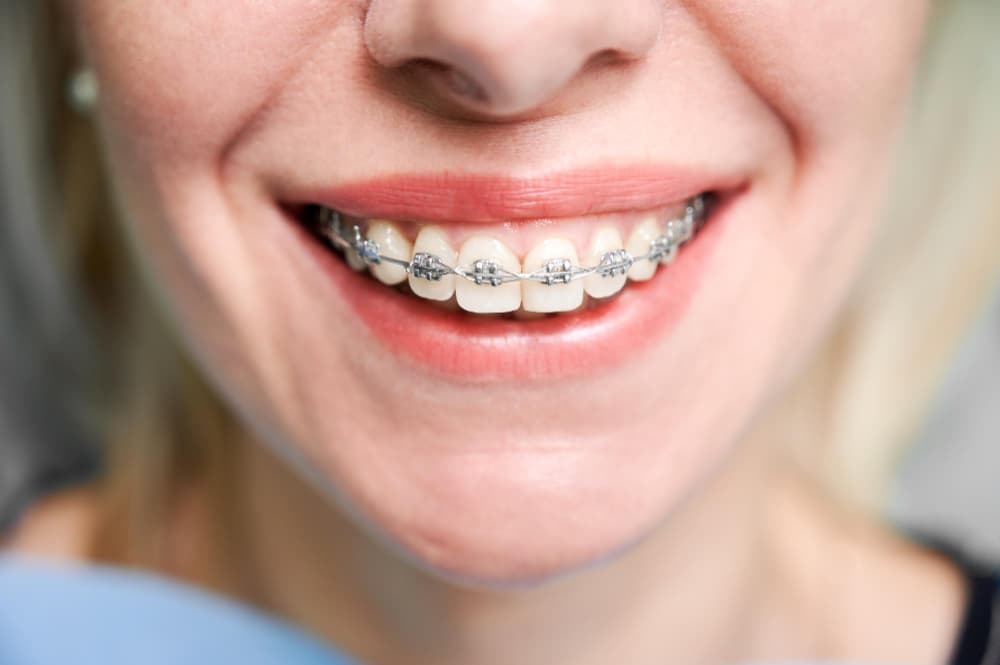
A close-up of a woman's teeth which have braces on them.
If you're considering orthodontic treatment in Noida, the first question you'll face is usually the same one: braces or aligners?
Both straighten teeth. Both work through sustained, controlled pressure on the teeth over time. Both require a commitment of months to years. But the experience of each is genuinely different — and the right choice depends on your specific teeth, your lifestyle, and your ability to commit to certain requirements.
At Renew Dental Clinic in Sector 47, Noida, this is one of the most common conversations Dr. Suchi Singh has with patients before any treatment begins. This guide reflects that conversation — honest, complete, and without a preference for one option over the other.
How Both Systems Work — The Common Ground First
Before comparing them, it helps to understand what braces and aligners share.
Both systems apply controlled, continuous pressure to specific teeth, causing the bone surrounding the roots to remodel — the bone on the pressure side gradually resorbs, the bone on the tension side fills in, and the tooth moves incrementally toward its target position.
Both require:
- A treatment planning phase before any appliance is fitted
- Regular appointments with the dentist for adjustments or progress monitoring
- A retention phase after treatment — retainers worn indefinitely to hold the result
Neither is faster by nature. For similar case complexity, treatment duration is comparable. The differences are in the experience, not the biology.
Traditional Braces — The Full Picture
How They Work
Stainless steel (metal braces) or ceramic brackets are bonded directly to the tooth surface. An archwire threads through all the brackets. Adjustments at each appointment change the wire or activate the system to apply force in the desired direction.
Braces are fixed. They are not removed by the patient at any point during treatment.
Advantages of Braces
No compliance requirement. Braces work regardless of patient behaviour (within reason). You cannot forget to wear them. You cannot leave them out during a stressful week. They're doing their job 24 hours a day.
Effective across all case complexity levels. Metal braces in particular handle severe crowding, significant overbites, complex bite corrections, and cases requiring substantial rotation of teeth — including back molars, which are among the most challenging teeth to move predictably.
More precise for complex cases. The bracket position on each tooth provides specific, three-dimensional control of tooth movement that aligner technology is still catching up with in the most complex scenarios.
Durability. Brackets don't get lost. There's no forgetting to put them in. The appliance stays active regardless of the patient.
Option for colourful bands. For younger patients, the elastic ties used in metal braces can be different colours — which many teenagers actively enjoy.
Disadvantages of Braces
Visibility. Metal braces are clearly noticeable when smiling or speaking. Ceramic braces are significantly less so, but still visible at a conversational distance.
Dietary restrictions. Hard, sticky, and chewy foods must be avoided throughout treatment — biting into an apple, eating corn on the cob, or chewing hard sweets can damage brackets. This requires ongoing dietary vigilance.
Oral hygiene demands. Brackets and wires create additional surfaces for plaque to accumulate. Cleaning around braces requires an electric toothbrush, interdental brushes, and floss threaders. Inadequate hygiene during brace treatment leads to cavities and white spot enamel demineralisation around the brackets.
Initial discomfort. After each adjustment appointment, the teeth are sore for 2 to 4 days as they adjust to new pressure. This resolves predictably but repeats with each visit.
Emergencies. Brackets can break. Wires can poke. These are not serious events but do require an unscheduled clinic visit for repair.
Clear Aligners — The Full Picture
How They Work
Custom-fabricated transparent trays of thermoplastic material sit over the teeth. Each tray is slightly different from the previous one, applying specific pressure to specific teeth. A new tray is introduced every 1 to 2 weeks, progressively moving teeth toward their target position.
Aligners are removable — taken out for eating, drinking (anything other than water), brushing, and flossing.
Advantages of Clear Aligners
Near-invisibility. During wear, aligners are virtually undetectable at conversational distance. For many adult patients — particularly those in professional or client-facing roles — this is decisive.
Removability. The ability to remove the aligner for eating, important meetings, social photographs, or sporting events is a significant quality-of-life advantage. You eat whatever you want; you remove the aligner first.
Simpler oral hygiene. Without brackets and wires, brushing and flossing continue normally. Teeth are easier to clean during aligner treatment than during brace treatment.
Fewer emergency visits. No brackets to break, no wires to poke. The most common aligner emergency is a lost or cracked tray — manageable by going back to the previous one while a replacement is made.
Generally comfortable. No sharp edges, no bracket irritation of the inner cheeks. New tray soreness exists — similar to brace adjustment soreness — but many patients find it milder.
Disadvantages of Clear Aligners
Compliance is everything. Aligners must be worn for 20 to 22 hours every day. Every hour the tray is out is an hour teeth are not moving. Patients who remove aligners for meals, snacks, and coffee throughout the day — and don't replace them promptly — will find their treatment extends significantly and results may be incomplete.
This is the most important disadvantage of aligners and is underplayed in marketing. Aligners require discipline that fixed braces do not.
Not suitable for all cases. Moderate to severe crowding, significant overbites and underbites, and complex bite corrections may not be fully achievable with aligners. The force mechanisms available with fixed braces allow more precise control of tooth movement in three dimensions, particularly for back teeth and rotational corrections.
Attachments make them less invisible. Many aligner cases require small tooth-coloured composite bumps bonded to specific teeth — called attachments — to give the aligner something to push against. These make the aligner slightly more visible and less "invisible" than the marketing suggests.
Cost. Clear aligners typically cost more than metal or ceramic braces, partly due to the laboratory fabrication cost and the number of trays required.
Discipline required for eating. The aligner is removed for every eating and drinking occasion. For patients who graze, drink tea or coffee multiple times a day, or have irregular mealtimes, replacing the aligner promptly after every episode is genuinely demanding.
Side-by-Side Comparison — The Honest Version
| Factor | Metal Braces | Ceramic Braces | Clear Aligners |
|---|---|---|---|
| Visibility | Clearly visible | Discreet | Near invisible |
| Effectiveness | All complexity levels | Mild to moderate | Mild to moderate |
| Removability | No | No | Yes |
| Compliance needed | Low | Low | Very high |
| Oral hygiene | More demanding | More demanding | Easier |
| Dietary restrictions | Yes | Yes | No |
| Emergency visits | Bracket breaks | Bracket breaks | Lost tray |
| Comfort | Initial discomfort | Similar to metal | Generally comfortable |
Who Should Choose Braces?
Metal or ceramic braces are the better clinical choice when
- The case is moderate to complex — significant crowding, bite correction, substantial tooth rotation
- The patient is a teenager or younger adult where compliance cannot be guaranteed
- The patient tends to forget or deprioritise health-related routines
- The aesthetic preference is for ceramic (discreet but reliable)
- Maximum treatment predictability is the priority
The core principle: If you're not absolutely confident you'll wear aligners for 20 to 22 hours every day, braces will produce a better result. The compliance requirement is real, and the consequences of poor aligner compliance are real.
Who Should Choose Clear Aligners?
Clear aligners are the better choice when
- The case is mild to moderate — spacing, minor crowding, relapse from previous treatment
- The patient is a self-motivated adult who will maintain the wearing schedule
- Aesthetics during treatment is a significant concern — for professional, social, or personal reasons
- The removability is genuinely useful — eating without restrictions, removing for specific occasions
- Dental hygiene and sensitivity to aligner compliance are both high
The Consultation at Renew Dental — Where the Real Decision Is Made
Patients who arrive at Renew Dental Clinic in Noida having already decided they want aligners sometimes leave with a recommendation for braces — not as bad news, but as the honest clinical finding.
And patients who arrive expecting to be told they need metal braces sometimes discover their case is straightforward enough for aligners to work beautifully.
The point is: the right decision is based on your specific teeth, your specific bite, and your specific lifestyle — not on what's being promoted. Dr. Suchi Singh's assessment process takes all of this into account.
After the consultation, you have a clear recommendation, the reasoning behind it, and all the information needed to make a confident choice.
Frequently Asked Questions
Can I switch from braces to aligners midway through treatment?
In some cases, yes — but it adds cost and complexity. It's better to discuss both options thoroughly at the outset and commit to one.
Do aligners hurt?
Switching to a new tray causes 1 to 3 days of mild soreness — similar to a brace adjustment. Most patients find this manageable and often milder than brace adjustments.
How do I clean my aligners?
Rinse with cool water after removing them. Clean daily with a soft toothbrush and mild clear soap or aligner cleaning crystals. Never use hot water — it warps the plastic. Never use toothpaste — it scratches the tray.
What happens at the end of aligner treatment?
Retainers are provided — typically clear retainers worn nightly. Without retainers, teeth drift back. This is true for both aligner and brace treatment.
Is there an age limit for either option?
No upper age limit for either. Aligners are generally not suitable for children and younger teenagers. Metal braces are appropriate from the age when most permanent teeth have erupted — typically 11 to 14.
Book Your Orthodontic Consultation at Renew Dental, Noida
The best way to know which option is right for your teeth is a consultation with **Dr. Suchi Singh at Renew Dental Clinic, Sector 47, Noida.
You'll leave with a specific recommendation, a realistic timeline, and a clear picture of what treatment involves — for whichever path makes clinical and practical sense for you.
To book, call (0120) 498-8333.
Open Monday–Saturday, 10:30 AM – 8:00 PM | Sunday, 11:00 AM – 2:30 PM.